
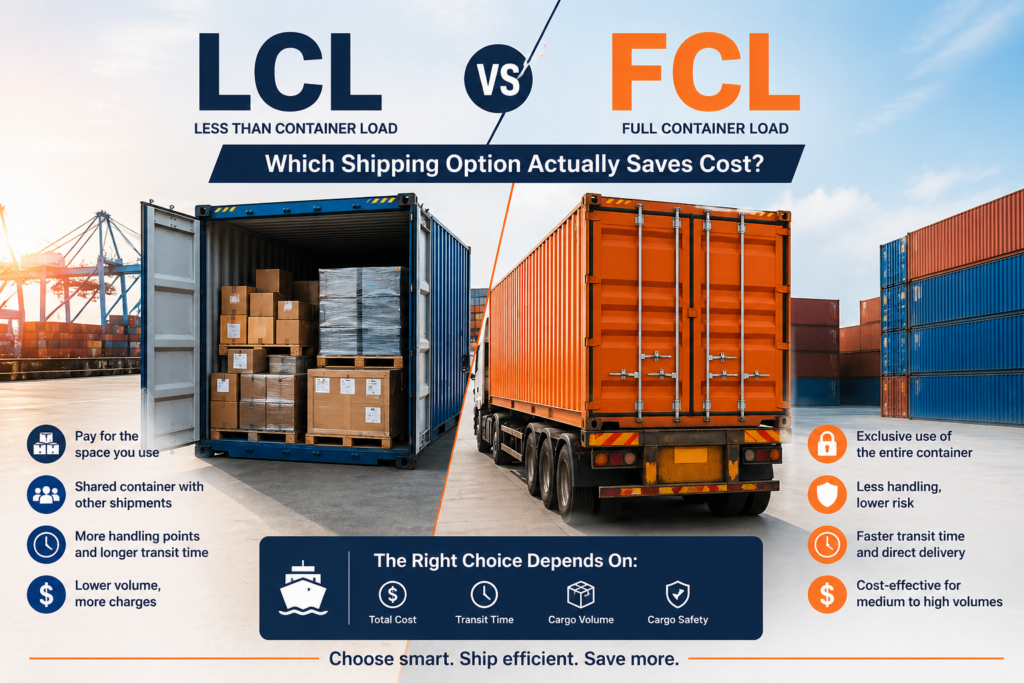
When planning an international shipment, one of the most common questions is:
Should I go for LCL or FCL?
Most people assume LCL is cheaper and FCL is expensive.
But in real logistics, that is not always true.
What is LCL (Less than Container Load)
LCL means your cargo is consolidated with other shipments inside one container.
You only pay for the space you use (CBM basis).
It is ideal when:
- Cargo volume is small
- Shipment is not urgent
- You want to avoid paying for a full container
However, LCL involves:
- Multiple handling points
- Consolidation at origin CFS
- Deconsolidation at destination CFS
What is FCL (Full Container Load)
FCL means you book the entire container for your cargo.
Even if the container is not fully filled, it is still exclusively yours.
It is ideal when:
- Cargo volume is high
- Shipment needs safety and control
- Transit time matters
FCL is more direct:
- Less handling
- Faster movement
- Lower risk of damage
Where most shippers go wrong
Many choose LCL thinking:
“Less cargo = lower cost”
But they miss the hidden charges:
- Origin CFS handling
- Destination CFS charges
- Deconsolidation charges
- Delivery delays
In some cases, LCL becomes more expensive than FCL.
Cost comparison reality
Here’s the practical logic:
If your cargo is around:
- 1–5 CBM → LCL makes sense
- 6–10 CBM → Compare carefully
- 10+ CBM → FCL is usually better
Because once volume increases:
LCL cost per CBM rises sharply.
FCL becomes more economical and predictable.
Transit time difference
LCL:
- Additional time for consolidation
- Additional time for deconsolidation
FCL:
- Direct container movement
- Faster delivery
If time is important, FCL is always better.
Risk and cargo safety
LCL:
- Mixed cargo from multiple shippers
- Higher chance of damage, contamination, or delays
FCL:
- Only your cargo inside the container
- Better control and lower risk
Simple decision rule
Don’t decide based only on cargo size.
Decide based on:
- Total landed cost
- Delivery urgency
- Cargo sensitivity
- Risk tolerance
Final insight
LCL is not always cheaper.
FCL is not always expensive.
The right choice depends on how you plan the shipment.
A small mistake in selection can increase cost, delay delivery, and create operational issues.
If you are planning a shipment and unsure which option fits your cargo, it is always better to evaluate both options before finalizing.
A correct decision at the booking stage saves cost and avoids problems later.