
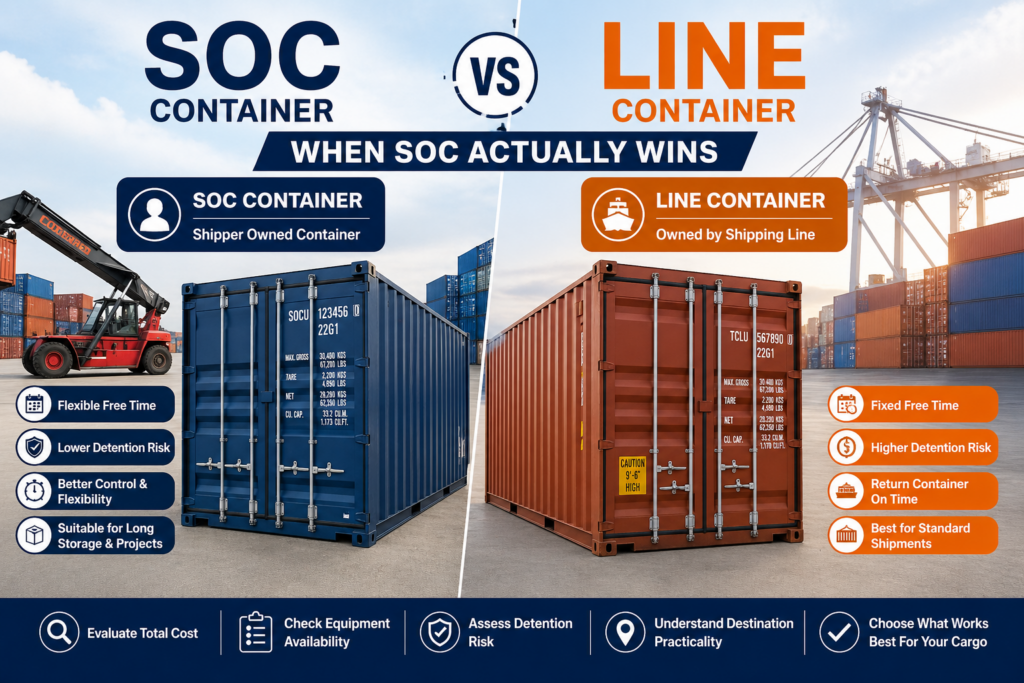
In container shipping, most shippers normally use line containers.
That means the container is provided by the shipping line.
But in some situations, using an SOC container can be a smarter option.
SOC means Shipper Owned Container.
It is a container arranged by the shipper, trader, forwarder, or logistics partner instead of using the shipping line’s own equipment.
What is a Line Container?
A line container is owned or controlled by the shipping line.
The shipping line provides the container for export, and after delivery, the consignee must return it within the allowed free time.
This is the most common model in regular FCL shipping.
It works well when:
- Equipment is easily available
- Cargo moves on standard routes
- Free time is enough
- There is no special equipment requirement
What is SOC?
SOC means Shipper Owned Container.
Here, the container is not supplied by the shipping line.
The customer or logistics provider arranges the container and books freight with the shipping line only for movement.
The container can be used for:
- Export shipment
- One-way movement
- Project cargo
- Storage purpose
- Repositioning requirement
- Long free-time requirement
Where SOC Actually Wins
SOC is not always the cheapest option.
But it wins when control matters more than normal container availability.
- When line equipment is not available
During peak season, shipping lines may not have enough containers at the required location.
This creates booking delays.
In such cases, SOC can help move cargo without waiting for line equipment.
- When detention risk is high
In line containers, the consignee must return the empty container within the allowed free time.
If clearance, delivery, or unloading gets delayed, detention charges can increase heavily.
With SOC, this pressure can reduce because the container is not controlled by the shipping line in the same way.
- When cargo needs long storage
Some cargo cannot be unloaded immediately.
For example:
- Project cargo
- Machinery
- Remote site delivery
- Cargo waiting for installation
- Site storage requirement
In these cases, SOC can work better because the container can stay with the cargo longer.
- When cargo is moving to difficult destinations
Some destinations have poor empty return options.
Shipping lines may not prefer sending their own boxes there.
For inland, remote, or special trade lanes, SOC may give better flexibility.
- When special equipment is required
Sometimes cargo needs:
- Flat rack
- Open top
- Tank container
- Reefer
- Modified container
If line equipment is limited, SOC can become the practical solution.
SOC is not always better
This is important.
SOC is not automatically cheaper or better.
Before choosing SOC, check:
- Container purchase or lease cost
- Condition of the container
- CSC validity
- Freight acceptance by shipping line
- Destination handling rules
- Customs and documentation requirements
- Empty repositioning plan after delivery
Without proper planning, SOC can create new problems.
Line container still works best when
Line containers are better when:
- Cargo is standard
- Route is regular
- Equipment is available
- Free time is enough
- Delivery is quick
- No long storage is required
For normal shipments, line container is usually simpler.
The real decision
The decision is not SOC vs Line Container.
The real decision is:
Which option gives better control, lower risk, and practical execution for this shipment?
Sometimes line container is better.
Sometimes SOC wins clearly.
Final insight
SOC wins when cargo needs flexibility.
Line container wins when the shipment is simple and standard.
The mistake is choosing only based on freight rate.
In shipping, the cheapest option on paper can become expensive during execution.
Always check the total picture:
- Equipment availability
- Free time
- detention risk
- cargo nature
- destination practicality
- long-term container use
That is how the right decision is made.
If you are planning SOC movement, project cargo, container trading, or special equipment shipment, Polaris Shipping Lines LLP can support with practical planning and execution.