
Recently, we handled an OOG machinery import from Singapore to Chennai.
The cargo reached the destination.
Delivery was taken.
Everything appeared fine at first.
But later, at the warehouse, the customer noticed damage in the cargo.
That’s where the real problem started.
What went wrong
By the time the damage was identified:
- Cargo had already been moved out of CFS
- No joint survey was conducted at the port
- No damage remarks were recorded at delivery
- No immediate intimation was given to the shipping line or surveyor
From a claims perspective, this becomes very difficult to handle.
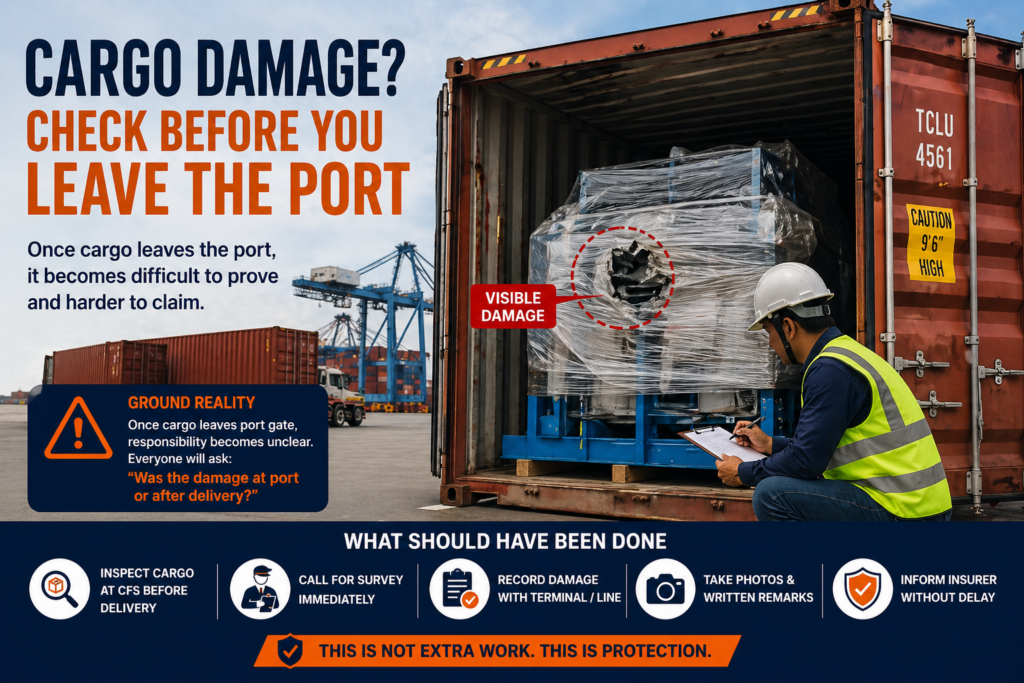
What should have been done
If there is even a small doubt about cargo condition:
- Inspect cargo at CFS before taking delivery
- Call for a survey immediately
- Record any damage with terminal / shipping line
- Take proper photos and written remarks
- Inform the insurer without delay
This is not extra work.
This is protection.
Ground reality
Once cargo leaves the port gate, responsibility becomes unclear.
Everyone will ask:
“Was the damage at port or after delivery?”
And without proper proof, answers don’t matter.
What we learn from this
In OOG and project cargo, risk is not just during movement.
It is also in how the cargo is received.
A small delay in inspection can lead to major financial loss.
Simple rule
Don’t confirm cargo condition at your warehouse.
Confirm it at the port — before taking delivery.
Because once cargo moves out:
- Options reduce
- Costs increase
Final note
If you are handling OOG or project cargo, proper inspection and survey at the right stage is critical.
If you need support for cargo inspection, survey coordination, or handling, Polaris Shipping Lines LLP can assist with practical execution.