
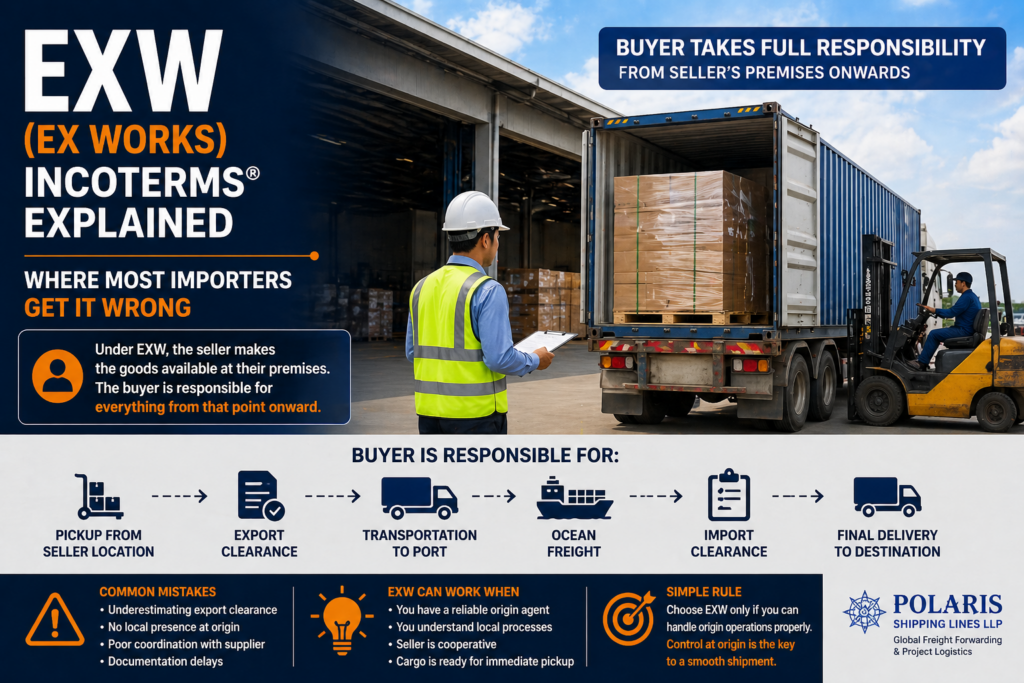
EXW (Ex Works) is one of the most commonly misunderstood Incoterms in international trade.
On paper, it looks simple.
But in real execution, EXW can create serious operational problems if not handled correctly.
What is EXW (Ex Works)
Under EXW, the seller makes the goods available at their premises (factory, warehouse, or location).
The buyer is responsible for everything from that point onward.
This includes:
- Pickup from seller location
- Export clearance
- Transportation to port
- Ocean freight
- Import clearance
- Final delivery
Where EXW looks easy
Many buyers prefer EXW thinking:
“I will control the shipment from origin.”
But they often underestimate what is involved at origin.
Where most importers go wrong
EXW puts full responsibility on the buyer — even at origin country.
That means the buyer must arrange:
- Local pickup in seller’s country
- Export documentation
- Customs clearance
- Coordination with origin agents
In many countries, this is not easy.
Especially when:
- You don’t have a local presence
- Seller is not cooperative
- Documentation is not properly handled
The real challenge with EXW
The biggest issue in EXW is export clearance.
In many countries, export clearance must be done in the name of the exporter.
If the seller is not actively supporting:
- Documents may be delayed
- Clearance may be rejected
- Shipment may get stuck
This creates unnecessary risk and delay.
Hidden risks in EXW
- Lack of control at origin
- Miscommunication with supplier
- Improper packing or handling
- Delay in pickup coordination
- Documentation mismatch
All these issues happen before cargo even reaches the port.
When EXW can work
EXW works better when:
- You have a reliable origin agent
- You have experience handling shipments in that country
- Seller is cooperative with documents and coordination
- Cargo is ready for immediate pickup
Without these, EXW becomes difficult.
Better alternative in many cases
In practical shipping, FOB is often safer than EXW.
Because:
- Seller handles export clearance
- Cargo reaches port properly
- Risk at origin reduces
This gives better control and smoother execution.
Simple decision rule
Choose EXW only if you can handle origin operations properly.
Otherwise, EXW may look cheaper, but becomes expensive due to delays and mistakes.
Final insight
EXW is not wrong.
But it is not always practical.
In logistics, control at origin is critical.
If origin is not handled properly, the entire shipment is at risk.
Choosing the right Incoterm is not about cost alone.
It is about execution.